Author: Emile Roux (emile
..This notebook is ready for RISE Slideshow
Source
# Setup
%matplotlib inline
import numpy as np
import matplotlib.pyplot as plt
import matplotlib

params = {
    "font.size": 14,
    "figure.figsize": (10.0, 6.0),
    "lines.linewidth": 2.0,
    "lines.markersize": 8,
}
matplotlib.rcParams.update(params)
General Scope
Optimization is the process of finding the best solution to a problem under a set of constraints. It is a fundamental concept in many fields, including mathematics, engineering, economics, and computer science. Optimization plays a critical role in various applications, including product design, scheduling, logistics, finance, and data analysis.
The goal of optimization is to find the optimal value of a function, which is a measure of the objective of the problem. The objective function can be either to maximize or minimize a certain quantity, depending on the nature of the problem. The optimal solution is the set of values of the decision variables that maximizes or minimizes the objective function while satisfying the constraints.
Optimization probleme formulation
The formulation of an optimization problem (minimization or maximization) goes through the following steps:
Objective: The goal to be achieved by optimization.
Variables: The elements that can be adjusted to achieve the objective.
Constraints: The limits or rules that must be respected during optimization.
Objective function: The mathematical function that must be optimized to achieve the objective.
Resolution method: The technique used to find the best possible solution taking into account the objective, variables, constraints, and the objective function.
Exemple of the design process
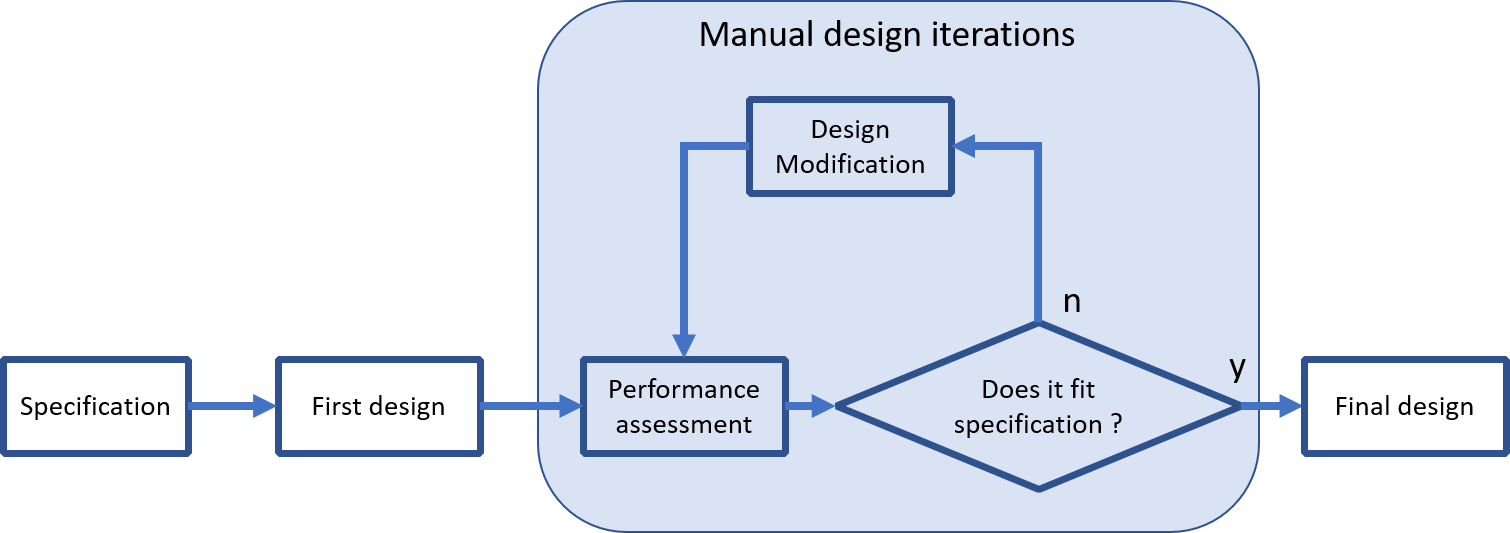
The conventional approach, described below, consists of a series of trial and error steps until a design that meets the specifications is obtained.
This approach, if it involves prototyping, can be very time consuming and resource intensive.
Automatique optimization can help to improve a design process.
The trial and error phase is replaced by an automatic phase: performance evaluation (cost function) combine with design modification.
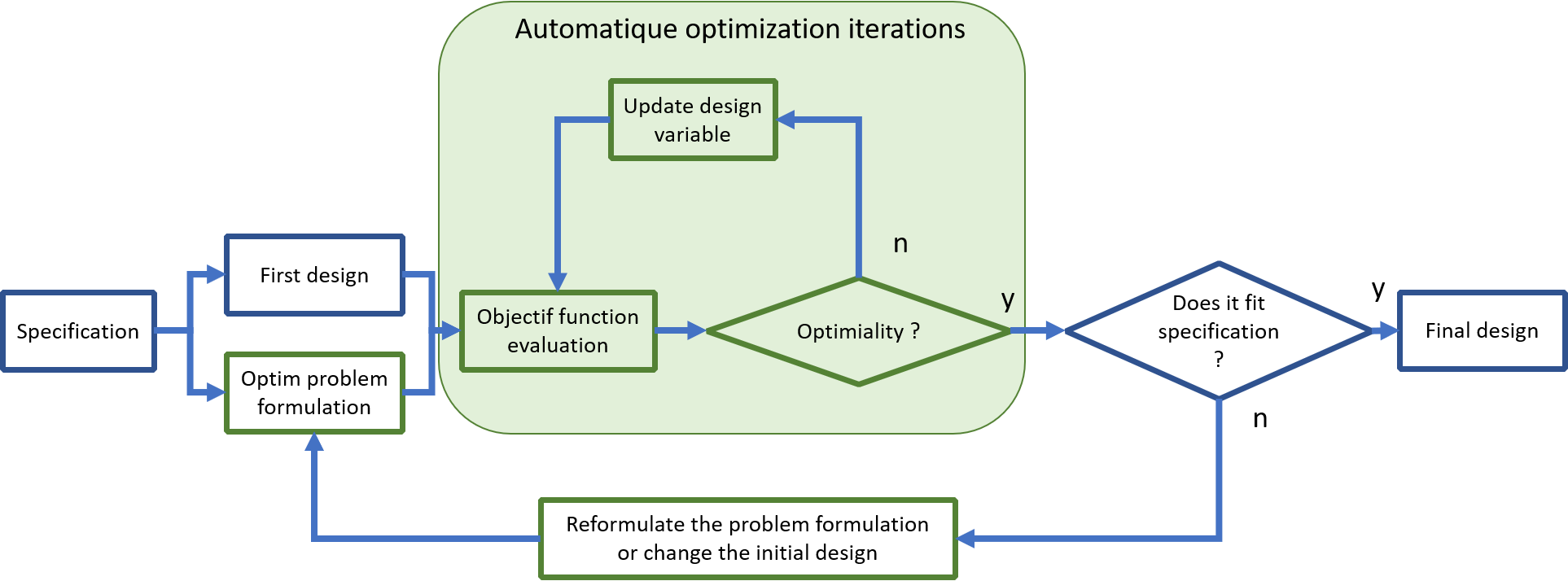
This automation allows to save time in the development process.
But it has a counterpart, it is necessary upstream to formulate the optimization problem and to be able to evaluate automatically a possible disgne.
{citep:ps}‘mdobook2022’
Mathematical formulation
Scope
Mathematical optimization aims at solving various kinds of problems by minimizing a function of the form:
Where if the cost function, is a dimensional vector of parameters and .
More informations about the underlying theory, the nature of the solution(s) and practical considerations can be found:
On Wikipedia,
On (excellent) Scipy lectures.
Solving
Scipy offers multiple approaches in order to solve optimization problems in its sub package optimize
General purpose approach
scipy
Below a basic exemple is presented :
Objective: Finde the mimimun au a finction .
Variables: .
Constraints: Nonz.
Objective function: .
Resolution method: Neder-mead methode (local minmum finding, an initial guess is mandatory).
from scipy import optimize


def f(X):
    """
    Cost function.
    """
    return ((X - 1) ** 2).sum()


X0 = [0.0, 0.0]  # Initial guess
sol = optimize.minimize(f, X0, method="nelder-mead")
X = sol.x
print("Solution: ", X)
Solution: [1.00002112 1.00003894]
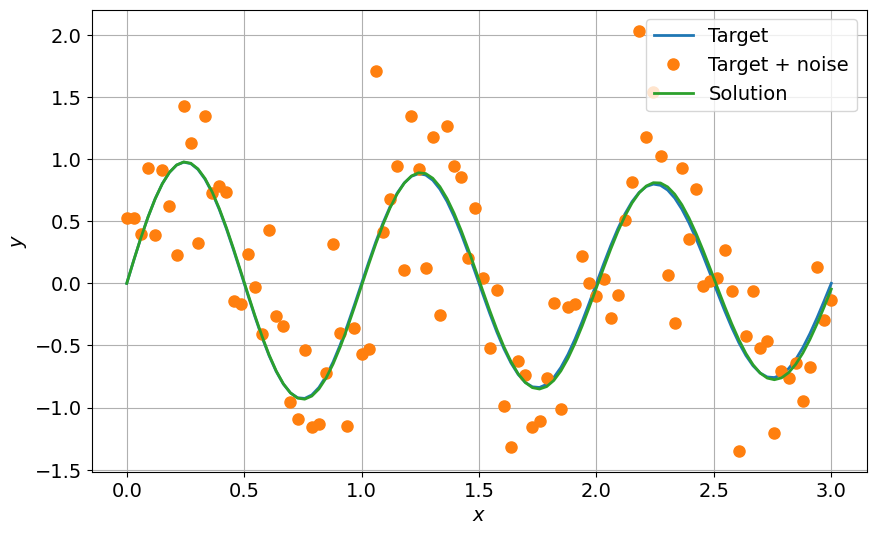
Specif case of curve fitting using least squares
In order to perform curve fitting in a more convenient way, scipy
def func(x, omega, tau):
    return np.exp(-x / tau) * np.sin(omega * x)


xdata = np.linspace(0, 3.0, 100)
y = func(xdata, omega=2.0 * np.pi, tau=10.0)
ydata = y + 0.5 * np.random.normal(size=len(xdata))

params, cov = optimize.curve_fit(func, xdata, ydata)
omega, tau = params
ysol = func(xdata, omega, tau)


fig = plt.figure(0)
plt.clf()
plt.plot(xdata, y, label="Target")
plt.plot(xdata, ydata, "o", label="Target + noise")
plt.plot(xdata, ysol, label="Solution")
plt.grid()
plt.xlabel("$x$")
plt.ylabel("$y$")
plt.legend()
plt.show()